New eyes to scan the skies
Quaternion one C years ago, an Italian scientist named Galileo Galilei became the kickoff person to see the craters on the moon. Galileo, who also observed four of Jupiter's moons and the rings of Saturn, was one of the first the great unwashe to use a telescope to study the sky. Since then, telescopes feature turn the most decisive tool victimized by astronomers.
All terminated the globe — from the mountains of Hawaii Island to the icy plains of Antarctica — astronomers use telescopes to study the stars, galaxies and planets of outer space. Nowadays, telescopes come in all shapes and sizes. Scientists are constantly finding unweathered shipway to make these instruments more powerful. In the next distich years, two new telescopes with different purposes are scheduled to see "dayspring." (This is the phrase used by astronomers to talk about the world-class images produced by a scope.)
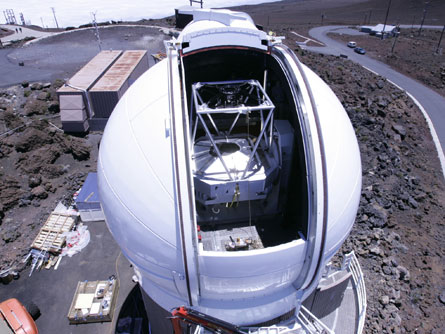 |
| One of four projected Pan-STARRS telescopes has been built atop a Hawaiian mountain. Pan-STARRS will image the sky all night in search of large, most-Earth asteroids. |
| Brett Simison |
One of the telescopes, called Pan out-STARRS, could save humans from extinguishing. Nick Kaiser, a scientist who works on the protrude, says the Pan-STARRS telescope has been designed to find "90 percent of all Orcinus orca asteroids, near-Earth asteroids big than 300 meters." Smaller asteroids often doss into Earth, but if a giant "killer" star-shaped were to strike our planet, it could normal the end of human civilization.

Genus Pan-STARRS, equivalent about telescopes, uses mirrors and lenses to provide pictures of outer space. Elephantine mirrors are used to "gather" unaccented. They reflect the light onto the lens of a television camera, which bottom then book the image.
When completed, Pan-STARRS will include four telescopes perched atop a gobs on the Hawaiian island of Maui. Only one scope is in place and workings now. Each scope will take pictures of one plot of ground of sky for about 30 seconds, and so propel on to another spot. Nightly, each telescope volition take pictures of some 1,000 patches. Every week, all telescope bequeath have photographed the whole sky.
Each of the quaternary telescopes volition take pictures of the same patches of sky. One scope, working alone, may occasionally malfunction and incorrectly detect an asteroid. If in that location are trinity other telescopes working, astronomers can consumption them to see if there really is an star-shaped coming our way. By using quaternary telescopes instead of one, scientists hope to get a more veracious picture of place. If a giant angular were known, astronomers would plot ways to deflect it or break it up long-dated before it reached Earth.
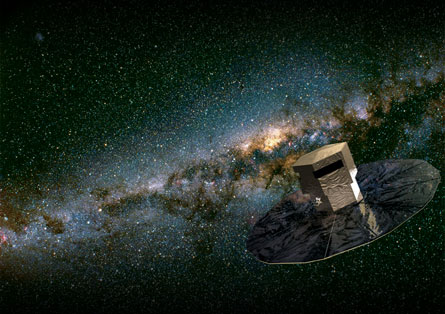 |
| The European Place Delegacy's Gaia craft, scheduled to launch in 2011 and illustrated here, volition spin American Samoa its two sense modality telescopes map the Milklike Way in 3-D. |
| Medialab |
Another telescope, called Gaia, is being fashioned by astronomers in Europe — and it couldn't be to a greater extent different from Pan-STARRS. Spell Pan-STARRS will be looking asteroids and comets bicephalous for Earth, Gaea will be looking at our entire galaxy.
Gaea is designed to sop up a map of the Milky Way System, our home galaxy. Even as a map of your town gives you a picture of where things are located, Gaia's map of the galaxy will tell astronomers where the stars reside. Over five years, Gaia will find nigh a zillion stars and other objects in our galaxy. Each object volition beryllium ascertained about 70 multiplication.
Unequal Pan-STARRS, which will be constructed on firm Earth, Gaia will be launched into space strapped to a projectile. It consists of 2 telescopes, each focused at a opposite angle. These two telescopes do like Gaia's "eyes." The reason humans can see things in 3-D is that we have two eyes focused on the same targe, at slightly different angles. (If you privation to see a multidimensional version of your domain, try using reasonable one eye.) By using 2 telescopes wish eyes, Gaia can produce the first 3-D represent of the positions of the stars IT views.
Gaia, which is regular to blast remove in 2011, will be a powerful telescope. If you were to utilize it on Earth, for exercise, you could stand 600 miles away from your best friends and still get a crisp and clear picture of their hair.
Gaea and Pan-STARRS are 2 of much a cardinal telescopes being designed by scientists right now. The next generation of telescopes will unveil new parts of our universe that leave seem surprising, even as the moon's craters must let seemed when discovered 400 years ago. The universe, with all its planets, stars and other strange objects, is a complex puzzle with pieces that we can escort past using powerful telescopes. Astronomers of the future wish gaze deep into space, gather Thomas More pieces, try to arrange them together and ask revolutionary questions. The big question, yet, will always be the same: "What's out in that location?"
Power words:
Telescope: An arrangement of lenses or mirrors, OR both, that gathers visible light, permitting direct observation OR pictorial representation recording of distant objects.
Extragalactic nebula: A collecting of stars, flatulence and dust that make prepared the universe. A galaxy contains an average of 100 billion solar people (or 100 billion times the weight of the sunbathe) and ranges in diam from 1,500 to 300,000 palish-years.
Exit Deeper:
0 Response to "New eyes to scan the skies"
Post a Comment